
Choosing an airbrush is about more than nozzle size or the number of accessories included in the box. For miniature painting, modeling, illustration, cake decorating, nail art, or other detailed work, the way an airbrush responds to the trigger, controls paint flow, and handles different spraying requirements can make a noticeable difference.
That is why hands-on testing is useful. A recent hands-on YouTube review tested by Studio ModelWorks tested Airgoo Phantom and Airgoo Gear Premium Airbrushes, examining everything from construction and trigger response to detail painting, shading, splattering, and maintenance. Both are positioned as hobby-grade or enthusiast airbrushes at around €79 at the time of the review.
Rather than simply comparing specifications, this review provides a useful look at how the two airbrushes behave in real projects.


Built for Detail and Everyday Hobby Use
The Phantom and Gear share a similar core configuration: both are dual-action, gravity-feed airbrushes and include 0.2 mm and 0.3 mm nozzle and needle options.

The Phantom comes with 3.5 cc and 7 cc color cups, while the Gear offers 4 cc and 7 cc options. Both packages also include a mini air filter, lubricant, replacement seals, and other maintenance accessories.

The reviewer paid particular attention to construction quality rather than simply looking at the exterior. On the Phantom, he found no visible defects, smooth mechanical movement, a well-centered needle, and a polished, straight needle. He also noted consistent color-cup wall thickness and good tolerances around the lid.
These details are easy to overlook when choosing an airbrush, but they can affect everyday spraying, cleaning, and long-term handling.
Trigger Response Makes a Difference
One of the most important parts of the test was the trigger.
The Phantom uses a slightly curved trigger designed to provide a comfortable contact point. After extended use, the reviewer particularly liked the trigger and handle shape, noting that the curved trigger felt smooth and potentially less fatiguing during longer sessions.
More importantly, the practical spray test produced a positive result.
Using black acrylic paint, the reviewer tested basic modeling techniques including dots, lines, and shading. He found that paint responded immediately when the trigger was pulled and stopped when it was released, without noticeable delay or paint continuing to bleed after release.
For detail-oriented airbrush work, predictable trigger response can be just as important as the nozzle size itself.
 Predictable Spray Control for Model Painting
Studio ModelWorks also evaluated how accurately paint landed on the target.
His test focused on basic shapes and patterns similar to the type of work commonly used for model painting. He found the spray pattern predictable and easy to control, particularly when working with dots, lines, and shading.
This makes the Phantom particularly relevant for hobbyists working on:
- Scale models
- Tanks and aircraft
- Miniatures and figurines
- Custom-painted objects
- Fine-detail hobby projects
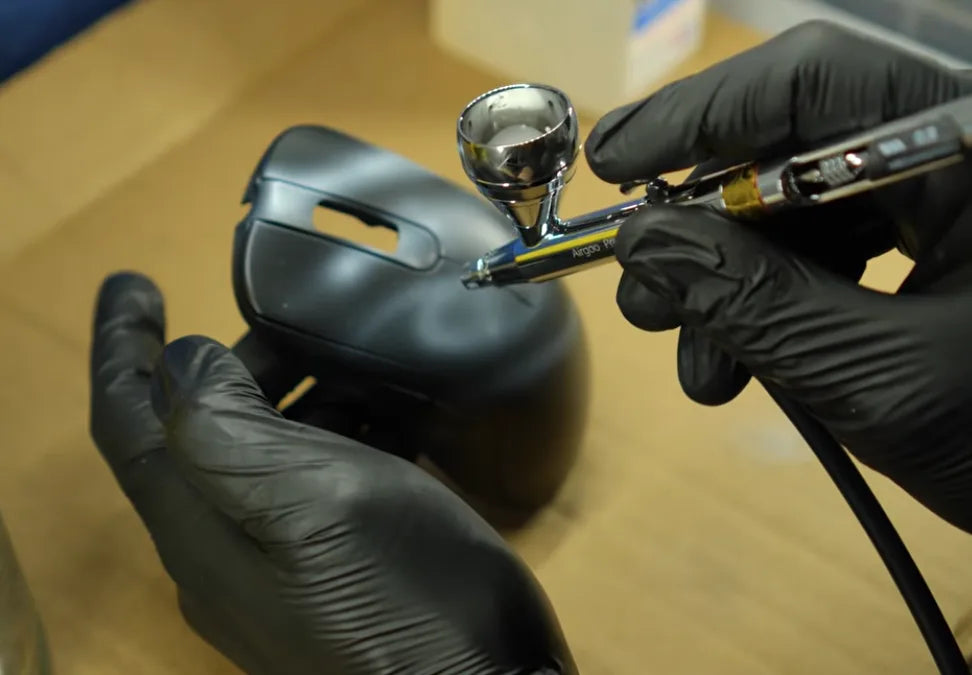
The test was not limited to paper, however. The reviewer also used the Phantom to create a custom space-themed paint job on a gaming mouse, combining primer, shading, highlights, fine lines, and controlled splattering.
That real-world project demonstrated how the airbrush could move between broad color application and smaller details within the same workflow.

0.2 mm or 0.3 mm: Flexibility When You Need It
Both Phantom and Gear include 0.2 mm and 0.3 mm nozzle and needle configurations, giving users the ability to adapt the airbrush to different painting requirements.
The reviewer notes that both units arrive with the 0.3 mm setup installed, while the 0.2 mm components are supplied separately. The smaller setup can be used when more detailed spraying is required.
In practical terms:
Having both options in the same package means users do not necessarily need to purchase a second airbrush simply because their projects change.

Phantom or Gear? Look Beyond the Name
The Phantom and Gear are very similar in overall performance, so the choice largely comes down to design preferences and a few practical differences.
The Phantom has a smoother body shape and a plastic insert inside the handle. After prolonged testing, the reviewer preferred this configuration for comfort. Its design also has a more futuristic appearance, which may appeal to modelers, sci-fi and robot enthusiasts.

The Gear takes a more traditional-looking approach while adding an unusual storage feature for the nozzle crown. Its quick-release crown can be removed for easier access during certain detail and clear-coat applications, then stored on the end of the handle. The reviewer liked the idea but felt that the connection could be more secure.
So instead of treating one model as universally better, consider what matters more to your workflow: body shape and handling, cup configuration, or the Gear's additional crown-storage feature.
Easy Maintenance Without Special Tools
Maintenance is another area where the review provides useful practical information.
The reviewer Studio ModelWorks found that the airbrush can be disassembled without special tools. The basic process involves removing the color cup and handle, releasing the needle clamp, removing the needle, and unscrewing the nozzle assembly.
The included maintenance kit and lubricant are also useful additions, particularly for users who are still learning how to maintain an airbrush correctly.
For the reviewer, the straightforward construction made cleaning and changing the nozzle setup relatively simple. The 0.2 mm and 0.3 mm configurations can therefore be changed according to the user's current project rather than requiring a completely different airbrush.

What Does the Review Tell Us?
The most useful takeaway from the test is not a single specification. It is how the Phantom and Gear come together as complete hobby airbrush systems.
The review found:
- Smooth mechanical operation
- Predictable trigger response
- Accurate and consistent paint placement during basic tests
- 0.2 mm and 0.3 mm nozzle options
- Practical designs for detailed hobby work
- Straightforward disassembly and maintenance
- Accessories included for setup and upkeep
After testing both models, the reviewer summarized his overall impression around value, emphasizing the combination of the airbrush itself, included accessories, construction, and practical performance at the price point available during the review.
For hobbyists looking for a dual-action gravity-feed airbrush for miniature painting, scale modeling, detail work, or creative projects, the Phantom and Gear offer two slightly different approaches built around a similar performance platform.
The best choice ultimately depends on how you hold your airbrush, the nozzle size you use most often, and which design features fit your workflow.
Explore the Airgoo Premium Series
Ready to put a new airbrush to work?
Check out the Airgoo Premium Phantom and Airgoo Premium Gear and choose the configuration that best matches your painting style and projects.
Kunhavigi:
Personalized Gifts You Can Create With an Airbrush
How to Choose Among Airgoo’s Three Airbrushes? AG-216 vs Gear vs Phantom?