
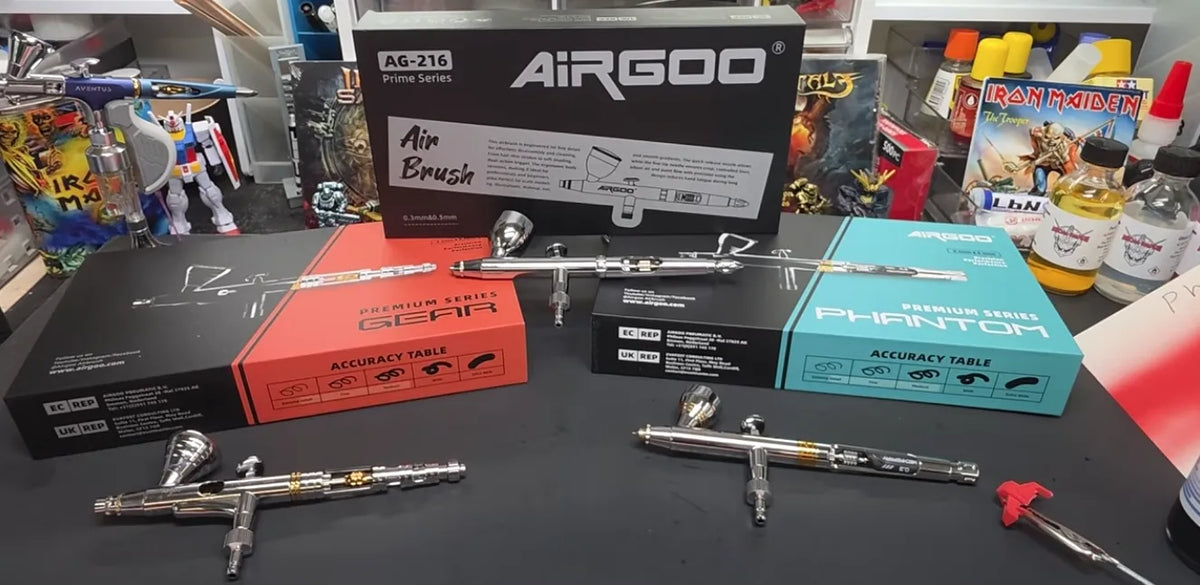
Which Airgoo airbrush is right for your painting style—the affordable AG-216, the premium Phantom, or the premium Gear?

That question was put to a real-world test by YouTube airbrush reviewer Barbatos Rex, who tested three new Airgoo dual-action gravity-feed airbrushes: the AG-216 with 0.3mm/0.5mm nozzles, Phantom with 0.2mm/0.3mm nozzles, and Gear with 0.2mm/0.3mm nozzles.
The test focused on what matters when an airbrush is actually in your hand: paint atomization, spray width, fine-line performance, paint flow, trigger comfort, and overall handling.
The result was notably positive across all three models. Barbatos Rex described the three airbrushes as highly impressive for their price, while also identifying meaningful differences in nozzle configuration, spray behavior, and ergonomics.
The Three Airgoo Airbrushes Tested
| Airbrush | Needle/Nozzle Options | Positioning | What the Test Highlighted |
| Airgoo AG-216 | 0.3mm / 0.5mm | Prime Series | Strong primer coverage, good atomization and versatile spray range |
| Airgoo Phantom | 0.2mm / 0.3mm | Premium Series | Fine atomization, comfortable trigger and detail-oriented performance |
| Airgoo Gear | 0.2mm / 0.3mm | Premium Series | Strong paint delivery, excellent atomization and comfortable control |
The AG-216 is the lower-cost option, while Phantom and Gear sit in Airgoo's Premium Series.
Airgoo AG-216: A Flexible Airbrush for Priming and General Painting
The Airgoo AG-216 stands out for its combination of 0.3mm and 0.5mm nozzle options. That wider configuration gives users more flexibility when switching between detail work and applications that require more paint.

During testing, the 0.3mm setup atomized paint effectively without flooding the surface. The 0.5mm setup was particularly useful for laying down primer and larger amounts of paint, while still producing reasonably fine lines when the airbrush was positioned correctly.

That makes the AG-216 a practical option if you do not want a dedicated detail airbrush and a separate primer or base-coat brush.
Why choose the AG-216?
The main advantage is versatility. A 0.3mm nozzle can handle general painting and relatively fine work, while the 0.5mm option provides additional paint capacity for primer and broader coverage.

For miniature painters, model builders, hobbyists, and anyone who regularly switches between priming and painting, this flexibility can be particularly useful.
The review also highlighted the substantial trigger mechanism and comfortable trigger feel, adding to its appeal as a general-purpose airbrush.
Airgoo Gear: More Paint Flow with Fine Atomization

Airgoo Premium Series Dual Action Gravity Feed Airbrush Gear with 0.2mm/0.3mm Nozzle
The Airgoo Gear uses the smaller 0.2mm/0.3mm configuration shared with the Phantom. However, the test revealed an interesting difference in paint delivery.
With the 0.3mm setup, the Gear produced a noticeably wider spray and pushed more paint than the other 0.3mm airbrush tested (Airgoo AG-216). Despite the higher paint output, it still atomized the paint very well.
This makes the Gear interesting for users who want the control associated with a smaller nozzle but also appreciate stronger paint delivery.
The 0.2mm setup produced very fine atomization, particularly when working closer to the surface and adjusting airflow appropriately. The reviewer described the spray as a fine mist and found the performance impressive.

Who is the Gear for?
The Gear can be a good choice when you want a detail-capable airbrush without limiting yourself to extremely low paint output.
It is suitable for detailed model work, controlled shading, miniature painting, and other applications where atomization and paint control matter.
Its trigger was also described as comfortable during testing, which is important when an airbrush is used for extended sessions.

Phantom and Gear's trigger mechanism. The reviewer specifically examined its ball-joint trigger construction and found the mechanism substantial and well guided. This is important for users who spend long periods controlling an airbrush, as a stable trigger mechanism can make paint flow easier to manage.
Airgoo Phantom: Fine Detail with a Different Feel
The Airgoo Phantom has the same 0.2mm/0.3mm needle and nozzle configuration as the Gear.

Airgoo Premium Series Dual Action Gravity Feed Airbrush Phantom with 0.2mm/0.3mm Nozzle
The test suggested that the two models perform very similarly, with the main distinction being their external design and ergonomics rather than a major difference in internal performance.
The 0.2mm configuration is particularly useful when fine atomization is the priority. Like the Gear, it can produce a very fine spray when the working distance and airflow are adjusted correctly.

One important difference is the way the brush feels in the hand. The reviewer preferred the Phantom's shape and noted that it fit his hand well. For users who spend a lot of time airbrushing, ergonomics can be just as important as nozzle size.

The review specifically noted that users with larger hands may prefer the Phantom's more substantial feel.
AG-216 vs. Gear vs. Phantom: Which Airbrush Makes Sense for You?
The three Airgoo airbrushes are designed around different combinations of nozzle size, paint output, handling, and application range. The test also suggests that price-to-performance is an important part of the equation.
Choose the AG-216 for versatility and value
The AG-216 is the most flexible option if you frequently move between primer, base coats, general painting, and finer work.
Its 0.5mm option provides additional paint flow for primer and broader coverage, while the 0.3mm setup offers more controlled everyday spraying. The reviewer was impressed by the quality and performance of the AG-216 considering its price.
Choose the Phantom for fine work and ergonomics
The Phantom is suited to users who prioritize fine atomization, detailed spraying, and comfortable handling.
Its 0.2mm/0.3mm configuration gives it a different focus from the AG-216, while the body design can be an important consideration for users with larger hands or anyone who spends extended periods airbrushing.
Choose the Gear for fine atomization with more paint output
The Gear uses the same 0.2mm/0.3mm configuration as the Phantom but demonstrated stronger paint delivery with its 0.3mm setup during the test.
If you want an airbrush capable of fine atomization while still putting down more paint when needed, the Gear offers a useful balance. Its comfortable trigger was another positive aspect noted during testing.
How does the price compare with the performance?
Price-to-performance was one of the strongest themes in the review. The tester described the AG-216 as impressive for its price of €29,99 and later commented positively on the €79,99 price point for the higher-end Airgoo brushes, concluding that the three models offered very good value for the money.
Rather than paying only for a specific nozzle size, buyers are getting features that directly affect day-to-day usability, including dual-action control, different nozzle configurations, substantial trigger mechanisms, good atomization, and distinct ergonomic designs.
For hobbyists who want better control than a basic entry-level airbrush while keeping the investment reasonable, the test suggests that Airgoo's lineup offers a strong balance between performance, versatility, and cost.
Final Takeaway
The test suggests that the choice between these three Airgoo airbrushes comes down less to whether one is simply "better" and more to what you need to spray and how you prefer an airbrush to feel in your hand.
For flexible painting and primer: AG-216
For fine detail and ergonomic handling: Phantom
For fine atomization with stronger paint flow: Gear
Overall, Barbatos Rex found all three brushes capable of strong performance and highlighted their comfortable triggers, good atomization, practical designs, and value for money. He also said he intended to use the brushes more frequently in his videos and daily airbrushing
Condividi:
Real-World Airbrush Testing: What to Know About the Phantom and Gear Premium Series